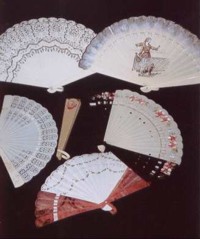
fig.1
Different celluloid-fans
[click the photo for more info]
CELLULOID-FANS
A short history of celluloid
The history
of celluloid is old and legendary. In 1863, John Wesley Hyatt saw an
advertisement. It promised 10.000 $ for an ivory substitute to produce
billiard balls. That was in the USA.
In Great Britain, a certain Mr. Alexander Parker experimented with artificial
substances in 1856 - and invented what was later on called "Parkesit".
In 1868, Mr. Hyatt patented his half-artificial substance and called
it celluloid, a mixture of cellulose, camphor and nitrate acid. Celluloid
could be produced in all forms and colours and had only one disadvantage:
it was highly inflammable. Very thin celluloid products do break easily.
Hyatt's invention was not an ideal substitute for ivory: if a jovial-happy
(or choleric-unhappy) billiard player tried to extinguish his cigar
in a celluloid billiard ball, the same exploded into flames
www.oregonknifeclub.org/celluloid.html].
Similar artificially produced substances were Bakelite (dark brown and
black) and Casein (light, in different colours). Products made of these
new substances became fashionable, were used for toilette, desk top
articles or weirder products such as collar and cuffs, "easy to
clean" and "waterproof" that needed neither starching
nor ironing.
Celluloid and fans
At the beginning, mainly fan sticks were produced, imitating ivory and tortoise-shell. But as a novelty, the material itself was quite expensive before mass production started. Celluloid imitations were very well done and it is rather difficult to distinguish them from the genuine product. Whereas false ivory (sometimes called "ivorine"), despite of artificial veining, might be detected, tortoise-shell is more difficult. Very thin Brisé-Fans or fan sticks seem to have a similar specific weight so that a 100% difference through "see, touch and feel" is hardly possible. Merchants tend towards selling all fans and fan sticks as the - considerably more expensive - tortoise-shell. With experience, one gets an inexplicable feeling, but there remain doubtful cases in which one should rather abstain from buying.
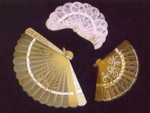
figb.2
Different celluloid-fans
[click the photo for more info]
