Georges BARBIER 1912
Georges
Barbier *1882 in Nantes, + 1932 in Paris
"Georges Barbier is one of the most prestigious and important artists
of our days...once this era is perished...fallen to dust...some of his
designs and water-colours will have survived, as testimony of the taste
and spirit of the years in which we live" said Albert Flament in
1922 (quoted in "Art Deco, Abiti, Costumi e Accessori" Ed.
Orsa Maggiore, translation by the author).
A. Flament was right. When typing the name Barbier into the search engines of the Internet, innumerable websites selling Barbier re-prints pop up. The person Barbier, though, remains in the dark. We do not know much about him. Just that he studied at the "Ecole des Beaux Arts" in Paris, together with his famous contemporaries Paul Iribe and Georges Lepape. Erté became one of his best friends. He himself received attention only in 1911, after he exhibited in the gallery Boutet de Monvel. Poiret, famous fashion designer of his time, engaged him (together with Iribe and Lepape) as fashion designers
In those times, Paris became "the" fashion centre. Influenced by exotic-oriental tastes following the world exhibitions and performances of Diaghilev's "Ballet Russe" (1909), a style was developed that received later on the name "Art Déco" (decorative art). But Barbier was also inspired by 18th century costumes that displayed a similar lust for entertainment and luxury, albeit in another style. Barbier worked for fashion journals such as "Gazette du Bon Ton", "Journal des Dames et des Modes" ,"Vogue" or "Harpers" and published himself "Falbalas et Fanfreluches" that could be translated as "Ruffles and Frills". Furthermore, he designed theatre costumes, costumes for the "Folies Bergères" and for the film by and with Rudolfo Valentino "Monsieur Beaucaire". Following the "Zeitgeist" he (as well as his other contemporaries) also designed fans that were often printed as publicity fans in thousands of copies.
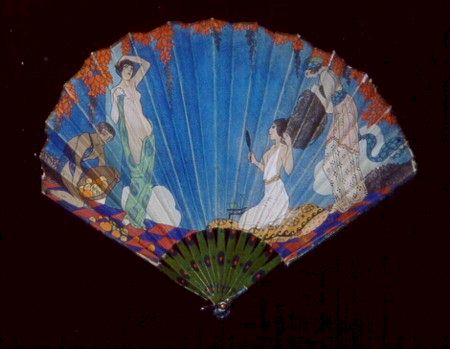
This particular fan is printed on silk, signed and dated "1912". There is a handwritten remark in the right red corner (see below) that says: Lubin. Thus, it can be assumed that this model was made for the perfume producer Lubin. The same fan (albeit with a slightly different pattern on the sticks) is published in several journals and books. It is entitled "publicity fan" (H. Alexander, Fans), "Ladies making their toilet" (article "Fächer, Zepter der Damen", in "Pan" 1985) or described as "exotic fan in the sultana style" (F. Falluel in "L'Estampille" 1985).

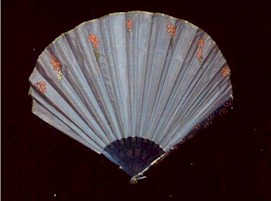
The sticks are made of bone and painted with ornaments that pick up designs of the fan leaf. The revers is made of blueish silk with some cascading floral decoration, reflected on the sticks. The balloon shape shows a scalloped profile when closed (see below).


Detail of the left side of the leaf
